I can’t help but remember the time I became curious about the history of the World Wars, both the first and the second. From The Diary of Anne Frank and The Boy in the Striped Pajamas (the novel) to various movies and TV series about the World Wars, such as The Imitation Game, Charité at War, The Bletchley Circle, and even Downton Abbey (lol), I’ve developed a fondness for learning more—whether it’s art or trivia related to them. Perhaps, at times, I could even re-write everything I’ve watched about the World Wars, despite the fact that I don’t particularly enjoy reviewing movies. As for the book review I’m writing, the theme of this book is similar to the spectacular movie Dunkirk. I appreciate both the movie and this book, despite the sad memories they evoke about the horrors of war.

Michael Veitch
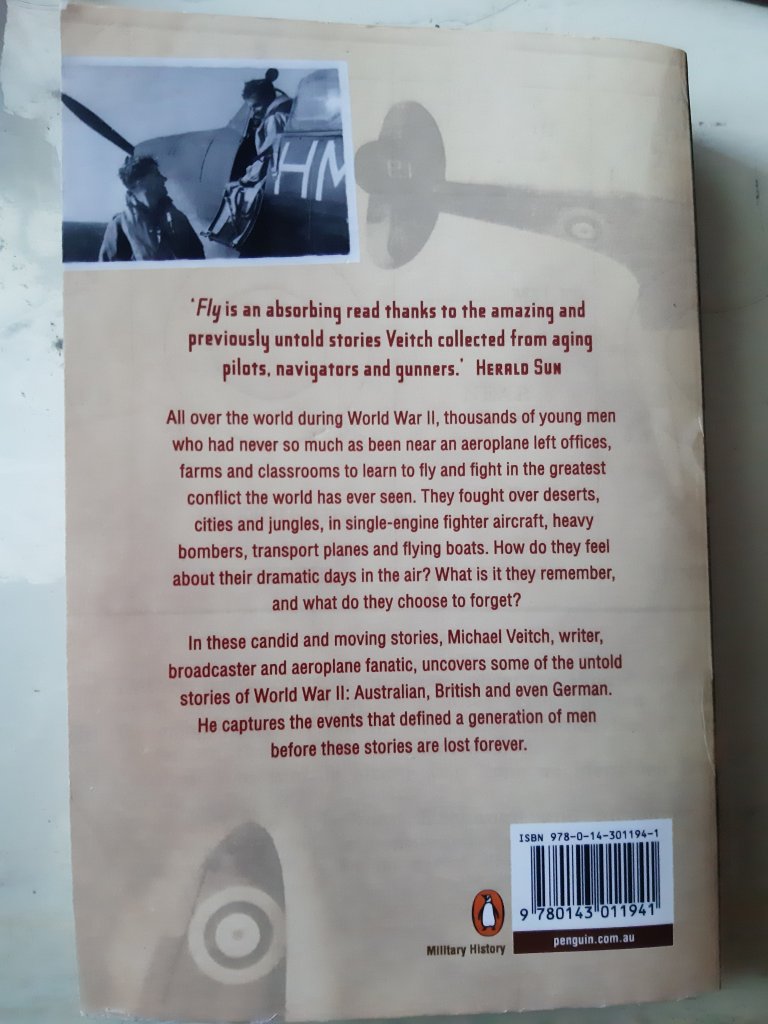
Well, I have finally finished the last page of this masterpiece, FLY – written by an author who is also known as a broadcaster on popular TV shows in Australia. For many readers, including myself, this is not just an ordinary book; it is a research work, a collection of biographies from history’s witnesses, discussing expertise, technology, and memory. These three hundred pages introduce readers to the pilots, air gunners, and navigators who fought during World War II. Interestingly, it covers not only the Royal Air Force (RAF), Royal Australian Air Force (RAAF), and Royal Navy Air Service (RNAS), but also the Luftwaffe. By reading this, I was able to explore and do a bit of further research on the differences between these air services.
However, this book seems underrated by reviewers on Goodreads. In my opinion, it even deserves a 4.5 out of 5. I tried to guess the expectations of the reviewers who gave it three out of five stars. Some of them might have found the plot and the paths of the historians similar: how they initially joined the air force, were selected to fight in the war, their memorable experiences while flying, the frightening moments during the war, and how they narrowly escaped death. Furthermore, some readers might have expected more pilots from other countries. I find myself in a similar position to those readers, wishing Michael Veitch had included more pilots from Germany (Luftwaffe) and other countries such as Italy and Japan. Additionally, from my point of view, either the editor or the writer could have added a sentence in each title to highlight the unique aspects of the airmen. This would have helped build awareness of these historians. For instance, Fred Phillips, Pilot – RAF, whose story goes beyond just being a senior pilot at Qantas.
Nevertheless, what Michael Veitch has done with this book is brilliant. Particularly for aviation enthusiasts, as he claimed in the book’s opening, he succeeded in creating a masterpiece of his dreams and for the science of world history, since not all of these airmen had exposed their stories in the media. Interestingly, I share the same curiosity about Adolf Hitler as Veitch, who confessed his astonishment when meeting Peter Alexander Mehrtens, a Luftwaffe pilot who had shaken hands with Hitler and claimed to have had a close relationship with Eva Braun. As a result, Mehrtens was placed on the first list of the other twenty airmen.
The idea of reading about one airman per day is a good way to give the reader space to absorb the connected history. Especially for those who are passionate about airplanes, they should enjoy exploring the Lancaster or the squadron. Since the book was written in advanced journalistic English, re-reading it is essential to build a comprehensive understanding of history. I remember a historical connection to Indonesia, told by Arthur Cundall – the navigator of the RNAS who defended the oil refinery in Palembang (South Sumatra) from the Japanese in 1942, three years prior to Indonesia’s Independence Day.
 a black mirror to read then to write